



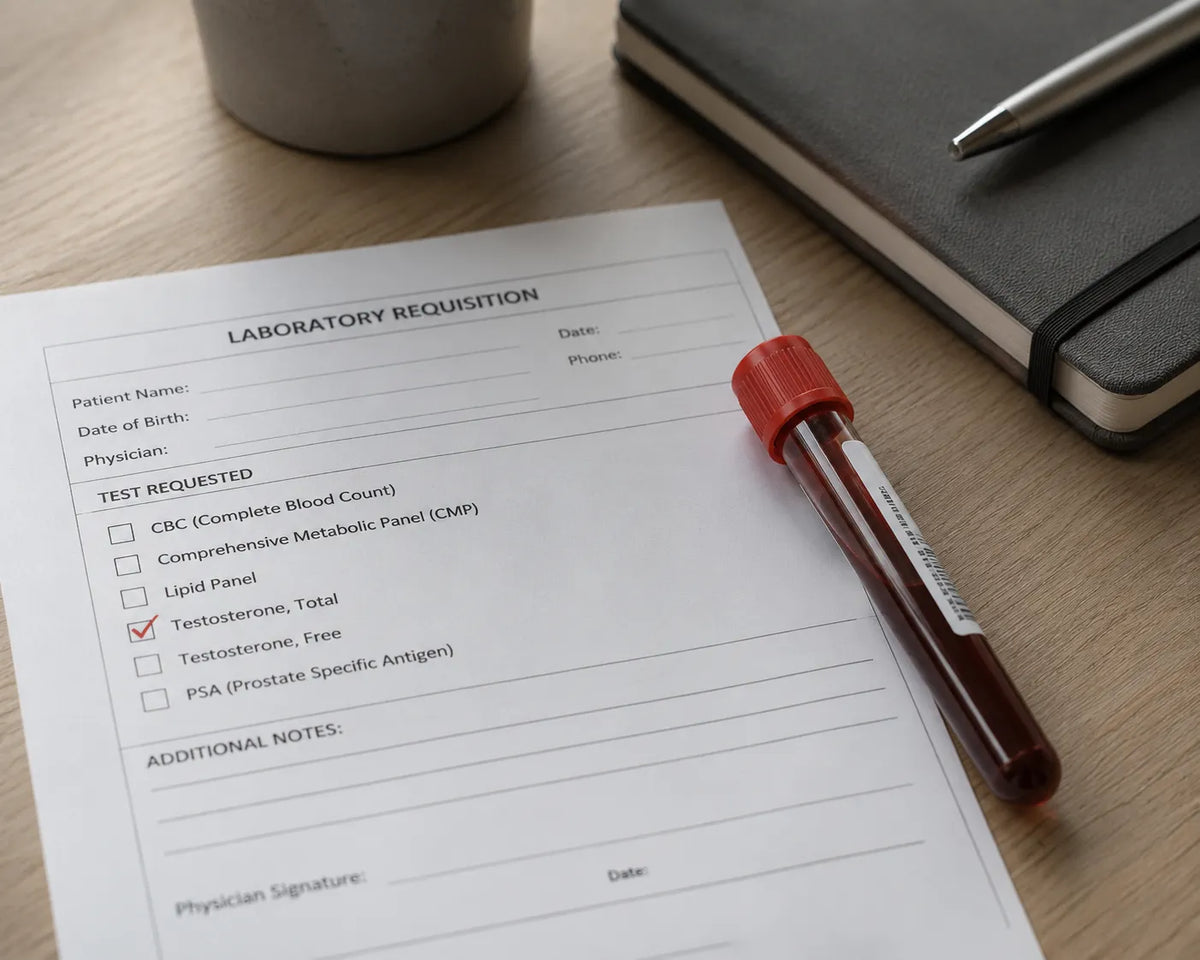
"How many tests are used for TRT" has no single fixed answer, and no single count applies to every client. Testosterone replacement therapy runs on three separate groups of blood tests: the draws that confirm low testosterone, a baseline panel that checks safety and cause, and ongoing monitoring after treatment starts. Most men can expect at least two morning testosterone measurements to confirm low levels, then further markers such as a complete blood count and a prostate-specific antigen (PSA). Marek Diagnostics provides direct-pay lab testing and a set of hormone testing options that match what clinical guidelines call for. The sections below break the count down, test by test, from the first draw through long-term follow-up.

How many tests are used for TRT?
There is no official count of how many tests are used for TRT. Clinical guidelines set a minimum sequence. It begins with at least two early-morning testosterone draws to confirm low levels (Mulhall et al., 2018), adds a baseline safety and cause panel of roughly four to eight more markers, then moves to periodic monitoring once therapy begins (Bhasin et al., 2018).
The exact number shifts with the clinical picture. It depends on whether the first testosterone result is low, whether sex hormone-binding globulin (SHBG) looks abnormal, whether fertility matters to the client, and how any prescribed testosterone is dosed. A short-acting injection and a daily gel do not follow the same monitoring calendar.
So the honest range is two confirmatory testosterone results before starting, a baseline panel that usually adds hematocrit, luteinizing hormone (LH), and other markers when indicated, then testosterone and hematocrit at the first follow-up and every 6 to 12 months after that (Mulhall et al., 2018). Chasing a 100-marker wellness panel is not what the guidelines require to start or continue treatment.
Blood tests that confirm low testosterone before TRT
Two total testosterone measurements, both drawn in the early morning on separate days, are the tests that confirm the diagnosis before any prescription (Mulhall et al., 2018; Bhasin et al., 2018). FDA-approved product labels use the same two-morning-sample rule (FDA, 2025).
The AUA identifies a total testosterone threshold below which further evaluation may be warranted, though it is one input and not a verdict on its own (Mulhall et al., 2018). A low level alone does not typically support a diagnosis without accompanying symptoms or signs. Guideline thresholds also differ in a way that reflects real disagreement between expert bodies, and the Endocrine Society and AUA don't agree on a single number (Bhasin et al., 2018; Mulhall et al., 2018).
Total testosterone versus free testosterone
Total testosterone measures all the hormone in the blood. Free testosterone measures the small fraction not bound to proteins. When total testosterone sits near the lower limit, or when SHBG may be high or low (from obesity, thyroid or liver disease, aging, or certain drugs), a free testosterone by dialysis result adds information total testosterone can miss (Bhasin et al., 2018). The Endocrine Society recommends measuring free testosterone by equilibrium dialysis or a validated calculation, not by a direct analog immunoassay, which it discourages. A separate SHBG test helps interpret a borderline total testosterone value.
Why one low result is not enough
A single low reading is a starting point, not a clinical confirmation. Testosterone varies with time of day, food, illness, and the assay itself, so a sizable share of first low results come back normal on a second morning draw, which is why the Endocrine Society calls for confirmation (Bhasin et al., 2018).
Assay quality matters too. The CDC certifies testosterone assays to a defined accuracy standard, which is why the lab and method matter (CDC, 2026). At-home finger-stick kits may be useful for screening, but current guidelines base the evaluation on a morning venous draw, repeated on a separate day, read on a certified method. A little planning before the visit helps; the practical points on fasting and timing are covered in this guide on how to prepare for blood work.
Baseline tests that check safety and cause
Beyond testosterone itself, guidelines call for a baseline panel that screens for the cause of low testosterone and for conditions treatment could worsen (Mulhall et al., 2018; Bhasin et al., 2018).
LH and FSH help providers distinguish between primary and secondary hypogonadism, and prolactin is added when LH is low or low-normal to point toward a pituitary cause. A complete blood count sets a baseline hematocrit, since testosterone can raise red blood cell concentration. The AUA advises a PSA test before treatment in men over 40. A metabolic panel (CMP) covers liver, kidney, glucose, and electrolytes, and a lipid panel plus a sensitive estradiol test round out the baseline when clinically indicated, since testosterone can convert to estrogen.
Fertility belongs in this conversation early. Exogenous testosterone can suppress sperm production, and recovery after stopping is variable and not guaranteed, so men who may want children in the future are encouraged to discuss fertility preservation with their provider before starting therapy, alongside LH, FSH, and a semen analysis (Mulhall et al., 2018). A baseline hormone panel can gather most of these markers in one draw.
A comparison of common TRT lab panels
The number of markers depends on the stage of care. The table below groups the common panels and what each one is for (Bhasin et al., 2018; Mulhall et al., 2018).
|
Panel |
What it usually includes |
Role |
|
Minimum diagnostic |
Two morning total testosterone results |
Confirms low testosterone; required by guidelines and FDA labels |
|
Guideline baseline |
Two testosterone results, free T or SHBG when indicated, LH and FSH, prolactin if indicated, CBC and hematocrit, PSA if 40 or older, estradiol if breast symptoms |
Screens cause and safety before treatment |
|
On-treatment monitoring |
Testosterone timed to the formulation, hematocrit, PSA per plan, blood pressure |
Tracks response and side effects |
|
Large wellness panel |
Extra metabolic, nutrient, and exploratory markers |
Not required to start or continue TRT |

Lab tests monitored during TRT
Once treatment starts, monitoring centers on testosterone, hematocrit, PSA, and blood pressure (Mulhall et al., 2018; FDA, 2025).
The first on-treatment testosterone check is timed to the formulation. A daily gel is often checked a few weeks in, drawn the day of application. Short-acting injections are checked after several cycles. After that, the AUA suggests testosterone every 6 to 12 months, a slower cadence than the first check (Mulhall et al., 2018). Hematocrit is checked at baseline and during the first months, then at least yearly, because testosterone raises red blood cell concentration (Bhasin et al., 2018). PSA follows a prostate-risk plan in the first year. Since the February 2025 FDA label update, blood pressure is a named monitoring item across the drug class (FDA, 2025). A set of follow-up lab panels can bundle the on-treatment markers.
When should testosterone be tested?
Testosterone peaks in the morning, so guidelines recommend early-morning draws, typically before 10 AM, for the most consistent results (Bhasin et al., 2018). For men on injections, timing within the cycle changes the reading; many providers prefer a pre-dose trough draw for a more consistent baseline. Fasting reduces variability. These timing details are part of why two draws taken at different times of day can disagree.
What do results that are too high mean for TRT safety?
Testosterone levels above the treatment range have not been shown to add clinical benefit and may increase certain risks. That is why monitored testosterone therapy includes regular lab work instead of a single starting test.
The clearest example is hematocrit. Guidelines set specific hematocrit thresholds at which providers should consider withholding or adjusting therapy, and at which starting treatment requires additional evaluation (Bhasin et al., 2018). A provider reviews these values in the context of each client's overall health. A 2025 single-center study found that a meaningful share of men on testosterone reached hematocrit levels that prompted clinical review (Neidhart et al., 2025). Other effects of running levels too high include acne, fluid retention, mood changes, and a rise in estradiol as excess testosterone can convert to estrogen through aromatization.
On the heart, the TRAVERSE trial of 5,246 men at high cardiovascular risk found similar rates of major cardiac events on testosterone and placebo, 7.0% versus 7.3%, but higher rates of atrial fibrillation (3.5% versus 2.4%) and pulmonary embolism (0.9% versus 0.5%) in the testosterone group (Lincoff et al., 2023). After TRAVERSE and the blood-pressure studies, the FDA in 2025 removed the older cardiovascular boxed warning and added a warning that testosterone can raise blood pressure (FDA, 2025). These findings have not changed guideline recommendations for men with diagnosed deficiency, though providers weigh cardiovascular risk factors on an individual basis (Bhasin et al., 2018; Mulhall et al., 2018). They are the reason a monitoring panel of cardiovascular risk markers and blood counts is tracked over time.
The gap between a lab reading and a confirmed condition matters here too. Biochemical low testosterone is common, but clinical hypogonadism, meaning symptoms plus confirmed low levels, is far less so. In the EMAS study of men aged 40 to 79, 2.1% met a symptom-plus-lab definition of late-onset hypogonadism (Wu et al., 2010). A single low result is a reason to discuss next steps with a provider, not a standalone indication for treatment.
Is TRT a shot?
No. Injectable testosterone is the most widely used form, but it is one of several FDA-approved routes (FDA, 2025).
Approved formulations include intramuscular and subcutaneous injections, a transdermal gel and solution, a transdermal patch, a buccal system placed against the gum, a nasal gel, and oral testosterone undecanoate capsules. Implantable pellets are also an approved route, and Marek Diagnostics does not provide pellet therapy. Each route changes the monitoring calendar and how blood draws are timed, which is one more reason the test count is a range rather than a fixed number. One caution belongs here. Compounded testosterone is not FDA-approved and is not equivalent to an approved product.
What the TRT test count comes down to
So the answer to how many tests are used for TRT is a sequence, not a single figure: two morning testosterone draws to confirm low levels, a baseline panel that adds hematocrit, LH, PSA, and other markers when indicated, then testosterone, hematocrit, PSA, and blood pressure tracked over time. The number follows the clinical picture, and every step sits under a licensed provider's evaluation, with a prescription written only after that review when it is medically appropriate.
Disclaimer: This blog post is intended for informational purposes only and should not be considered medical advice. Always consult a healthcare professional before making changes to your health routine.
FAQs
How many tests are used for TRT before starting?
At least two early-morning testosterone draws confirm low levels, plus a baseline panel that usually adds hematocrit and, under AUA guidance, LH. A PSA is added for men over 40. FDA-approved labels use the same two-morning-sample rule (Mulhall et al., 2018; FDA, 2025).
Is one low testosterone test enough to start TRT?
No. The Endocrine Society and AUA call for a second early-morning measurement, because time of day, food, illness, and assay differences can move the result (Bhasin et al., 2018). Clinical confirmation also needs symptoms or signs, not a low number on its own.
How many tests are used for TRT monitoring after starting?
Monitoring centers on testosterone, hematocrit, PSA, and blood pressure. The first testosterone check is timed to the formulation, then the AUA suggests testosterone every 6 to 12 months, with hematocrit at least yearly (Mulhall et al., 2018). Blood pressure became a labeled monitoring item after the FDA's 2025 update (FDA, 2025).
Why do CBC and PSA matter for TRT?
A complete blood count tracks hematocrit, since testosterone can raise red blood cell concentration; guidelines set specific hematocrit thresholds at which providers should withhold or adjust therapy (Bhasin et al., 2018). PSA screens prostate health before and during treatment, which is why the AUA recommends it for men over 40 (Mulhall et al., 2018).
What is the difference between total and free testosterone testing?
Total testosterone is the first test. Free testosterone measures the unbound fraction and is added when total testosterone is borderline or when SHBG may be abnormal. The Endocrine Society recommends measuring free testosterone by equilibrium dialysis or a validated calculation rather than a direct analog immunoassay (Bhasin et al., 2018).
Is TRT only given as a shot?
No. Injectable testosterone is the most common form, but FDA-approved routes also include transdermal gels and solutions, a patch, a buccal system, a nasal gel, and oral testosterone undecanoate (FDA, 2025). Compounded testosterone is not FDA-approved and is not equivalent to an approved product.
References
-
Class-Wide Labeling Changes for Testosterone Products. FDA. 2025.
-
Hormone Standardization Program, Total Testosterone. CDC. 2026.
Share:
Men's Hormone Panel: Which Thyroid And Adrenal Tests Matter
Can TRT Blood Test Results Change From One Test To Another