



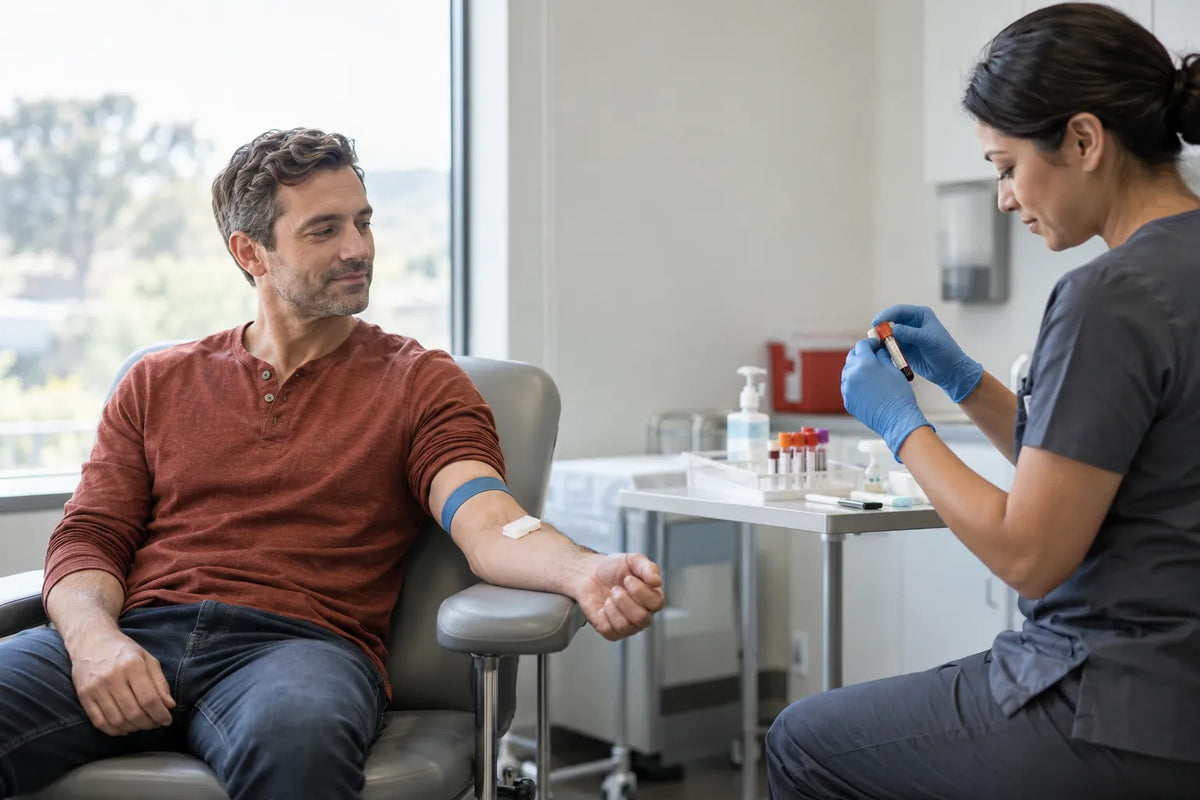
The blood tests required before TRT do two things: they confirm whether your testosterone is low, and they give your provider the information to decide, with you, whether therapy may be appropriate. Marek Diagnostics and the major clinical guidelines treat lab work as a key input in deciding whether treatment is appropriate, not a formality after a prescription is written. At a minimum, that means two early-morning total testosterone draws, plus tests for the hormones that regulate testosterone and the safety markers testosterone can push out of range. The American Urological Association puts this workup before the prescription, and requires two measurements for a diagnosis (Mulhall et al., 2018). What follows is the full baseline panel: the biomarkers, why each one is on the list, when to draw them, and how to read the results before you start.
What blood tests are required before TRT? The baseline panel covers total and free testosterone, SHBG, LH, FSH, estradiol, prolactin, PSA, a complete blood count for hematocrit, a metabolic panel, and a lipid panel. A diagnosis needs two low early-morning testosterone results plus symptoms, per the AUA and Endocrine Society.

Why Pre-TRT Blood Work Matters
Testosterone is a Schedule III controlled medication, and guidelines generally support prescribing it only for diagnosed hypogonadism, meaning low levels together with symptoms, rather than low levels alone (Bhasin et al., 2018). Blood work is what separates those two cases.
The blood tests required before TRT exist as a gate, not a formality, and three jobs sit on that baseline panel. It confirms the deficiency against an accurate assay. It points to the cause, since a pituitary problem and a testicular one are treated differently. And it catches the conditions that make therapy risky before any medication is involved. Testosterone can raise red blood cell levels and can affect prostate tissue, so a pre-treatment reading of hematocrit and PSA sets the reference point every later result is measured against. Skipping that baseline means a later rise has nothing to be compared to. The specific hormones checked before starting are chosen to answer all three questions at once.
Blood Tests Required Before TRT: The Core Panel
The AUA and Endocrine Society converge on one baseline set: confirm low testosterone on two morning draws, work out the cause, and screen the markers testosterone can move (Mulhall et al., 2018; Bhasin et al., 2018). Here is each biomarker and the reason it belongs on the order.
Hormone and pituitary markers
Total testosterone. Two separate early-morning draws, 7 to 10 a.m., fasting, run by the same lab and assay. The AUA uses a total testosterone below 300 ng/dL as a reasonable cutoff supporting a diagnosis when symptoms are present, a Moderate Recommendation at Evidence Grade B (Mulhall et al., 2018). Morning timing matters because levels peak early and fall through the day, which is why a morning testosterone test is the standard.
Free testosterone and SHBG. Total testosterone counts hormone that is bound and unavailable. Free testosterone is the unbound fraction your tissues can use, and SHBG is the protein that controls how much stays bound. Both are worth measuring when total testosterone sits near the lower limit, or when obesity, diabetes, or thyroid disease shift SHBG and make the total misleading.
LH and FSH. These pituitary hormones separate primary hypogonadism (a testicular problem, LH runs high) from secondary hypogonadism (a pituitary or hypothalamic problem, LH is low or low-normal). The AUA gives measuring LH a Strong Recommendation at Grade A (Mulhall et al., 2018). The cause changes the conversation about fertility and about whether imaging is needed.
Prolactin. Checked when testosterone is low and LH is low or low-normal, to catch a pituitary cause such as a prolactinoma. This is also a Strong Recommendation at Grade A (Mulhall et al., 2018). A treatable pituitary tumor is the kind of finding a baseline panel exists to surface.
Estradiol. Testosterone converts to estradiol through the aromatase enzyme. A baseline estradiol is called for when a man has breast tenderness or gynecomastia before starting, so later estradiol levels have a starting point to be read against.
Safety and organ-function markers
Complete blood count (hematocrit and hemoglobin). Testosterone can raise red blood cell concentration, a condition called erythrocytosis, which can thicken the blood and may raise the risk of clotting in some people. A baseline CBC is a Strong Recommendation at Grade A, and an elevated baseline hematocrit, above 50%, is a reason to hold therapy and investigate the cause first rather than add to it (Mulhall et al., 2018).
PSA. For men over 40, a baseline prostate-specific antigen is drawn before the first dose, so your provider has a starting point to monitor prostate health and interpret any later change. The AUA frames this as a Clinical Principle. A baseline PSA level is what makes a future rise interpretable.
Metabolic panel (CMP). This checks liver enzymes, kidney markers, glucose, and electrolytes, so organ function is documented before therapy. The same panel is tracked later, which is why liver and kidney function belongs in the baseline, not only the follow-up.
Lipid panel. A baseline cholesterol and triglyceride reading documents cardiovascular risk before starting, which matters given the blood-pressure warning the FDA added in 2025 (covered below).
Thyroid. Thyroid disease produces fatigue, low libido, and low energy that look like low testosterone and also shift SHBG. Running thyroid testing before TRT keeps a treatable thyroid problem from being mistaken for hypogonadism.
You can order these as single markers from the individual biomarkers menu, or as pre-built lab bundles built around the pre-TRT workup, including a dedicated testosterone lab panel.

Why Two Early-Morning Tests Instead of One?
One low result is not enough to start therapy. The AUA requires two early-morning total testosterone measurements on separate days for a diagnosis, a Strong Recommendation at Grade A, so a single low reading does not establish the diagnosis on its own (Mulhall et al., 2018).
The reason is variation. Testosterone peaks in the early morning and drops later in the day, and it swings day to day. A poor night of sleep, a passing illness, or an afternoon draw can read falsely low. A single number can send a man onto a controlled medication he does not need, or miss a real deficiency. A repeat draw, run on the same assay, guards against both, because testosterone tests vary between labs and methods more than most people expect.
When Should You Schedule the Draw?
Draw between 7 and 10 a.m., after fasting, and not during an acute illness (Bhasin et al., 2018). Morning timing captures the daily peak, fasting avoids the drop in testosterone that food and glucose cause, and skipping a sick week keeps a transient dip from being read as a baseline.
One practical note that trips up accurate results: high-dose biotin supplements can interfere with some hormone immunoassays, so stopping biotin a few days before the draw protects the reading. If you want the full list of things that move a result, review what to avoid before the appointment.
What Labs Come Next Once Therapy Starts?
Baseline is the first half of the job. After starting, guidelines re-check testosterone and hematocrit and reassess prostate risk within the first year, then periodically after that (Bhasin et al., 2018). Hematocrit is watched because testosterone raises it over time; estradiol and PSA are tracked against their baselines; blood pressure is now on the list too.
That last point changed recently. In February 2025, the FDA made class-wide labeling changes to testosterone products: it removed the boxed warning about cardiovascular risk after reviewing the TRAVERSE trial, added a warning about increased blood pressure, and kept the Limitation of Use stating testosterone is not approved for low levels due to aging alone (FDA, 2025). TRAVERSE itself followed 5,246 men with low testosterone and existing or high cardiovascular risk, and found no increase in major cardiac events on testosterone versus placebo, 7.0% against 7.3%, but it did record higher rates of atrial fibrillation and pulmonary embolism in the testosterone group (Lincoff et al., 2023). A baseline that flags a clotting history or heart risk is what lets a provider weigh that signal for you specifically. The full set of biomarkers to monitor grows out of the same baseline panel.
Access follows the same conditional logic. Testosterone is prescribed only after a clinician evaluates your labs and symptoms. A temporary DEA and HHS extension of telemedicine prescribing flexibilities lets licensed clinicians prescribe it online without a prior in-person visit through the end of 2026, where state law permits, so the route to a prescription is lawful but conditional, never automatic.
Making Sense of Your Baseline Results
A lab value is read against symptoms and the assay, never on its own (Bhasin et al., 2018). Reference ranges differ from lab to lab, so one number labeled "normal" does not settle whether therapy is right for you. A diagnosis needs the pattern: a low level, confirmed on a second morning draw, alongside symptoms, with the cause worked out from LH, FSH, and prolactin.
Targets are set by your provider from your results, not from a figure online. Fertility is part of that conversation up front, because testosterone can suppress sperm production, and recovery after stopping is variable and not guaranteed. Men who want to preserve fertility can discuss options with their provider before the first dose.
The blood tests required before TRT are not a box to tick on the way to a prescription. They confirm the diagnosis guidelines ask for, surface the pituitary and prostate findings worth catching early, and set the baseline every later dose decision and safety check is measured against. Testing first, and testing correctly, supports safer and more individualized care, and you can see the exact markers and build your pre-TRT order through the lab builder.
Disclaimer: This blog post is intended for informational purposes only and should not be considered medical advice. Always consult a healthcare professional before making changes to your health routine.
FAQs
Do you need two blood tests before starting TRT, or is one enough?
Two. The AUA requires two early-morning total testosterone measurements on separate days for a diagnosis, a Strong Recommendation at Grade A. A single low result can reflect a bad night's sleep, a passing illness, or normal daily variation, so one test is not enough to start a controlled medication.
What blood tests are required before TRT?
The baseline panel covers total and free testosterone, SHBG, LH, FSH, estradiol, prolactin, PSA for men over 40, a complete blood count for hematocrit, a metabolic panel, and a lipid panel. The AUA and Endocrine Society require that testosterone be confirmed low on two morning draws alongside symptoms before therapy starts.
What time of day should a testosterone blood test be drawn?
Between 7 and 10 a.m., after fasting. Testosterone peaks in the early morning and falls through the day, and food lowers it, so the Endocrine Society calls for a fasting morning draw to get a reading that reflects your real level rather than the time of day.
Why are LH and prolactin checked before TRT?
To find the cause. LH separates a testicular problem (LH high) from a pituitary one (LH low or low-normal), and prolactin, checked when LH is low, can reveal a pituitary tumor such as a prolactinoma. The AUA rates both as Strong Recommendations at Grade A because the cause changes treatment.
Is a hematocrit blood test required before TRT?
Yes. A baseline complete blood count for hematocrit is a Strong Recommendation at Grade A, because testosterone can raise red blood cell concentration and thicken the blood. An elevated baseline hematocrit, above 50%, is a reason to hold therapy and investigate before starting.
Does a "normal" testosterone result mean my levels are fine?
Not by itself. Reference ranges vary between labs and assays, and a value inside a range can still sit low for you. A diagnosis needs a consistently low level confirmed on a repeat draw, plus symptoms, read in context by a provider rather than against a single cutoff.
Can telehealth prescribe testosterone after labs without an in-person visit?
Under a temporary DEA and HHS extension of telemedicine flexibilities, yes, through the end of 2026 and where state law permits. A licensed clinician still has to evaluate your labs and symptoms first. Prescription is required after that evaluation, and the online route is conditional, not guaranteed.
Share:
Testosterone Testing For TRT: Which Labs And When To Draw